Local News
Changes at Lebanon Animal Control Lead Pound Pullers Founder to Step Back After 12 Years
By Lebanon Now Staff ·

Changes at Lebanon Animal Control Lead Pound Pullers Founder to Step Back After 12 Years
A longtime partnership that has helped move thousands of animals from the Lebanon Animal Shelter into rescue organizations and homes reached a crossroads this week after Pound Pullers founder Tanya Dunn announced she would step away from networking animals from the city facility.

Dunn’s Facebook post Thursday quickly spread across the community, with residents expressing concern about what the change could mean for animals at the shelter and whether it could lead to an increase in euthanasia.
Lebanon Now spoke separately with Dunn, Lebanon Police Chief Jerry Harrison and Animal Control Manager James “JT” Taylor to better understand what changed, why Dunn is stepping back, and what Animal Control says will happen moving forward.
At the center of the disagreement is a rescue reservation policy that became effective June 15, along with a larger effort by the Lebanon Police Department to formalize policies and procedures within Animal Control.
Twelve Years of Pound Pullers
For more than 12 years, Dunn has served as the central connection between Lebanon Animal Control and a network of rescue organizations, donors and volunteer drivers.
Under the system Dunn described, once an animal’s required stray hold expired, Animal Control would send her photographs and information. Dunn would then contact rescue organizations to find one willing to accept the animal.
Her supporters would often pledge money to the receiving rescue to help cover veterinary care, food, spaying or neutering and other expenses. Once a rescue agreed to take the animal, Dunn coordinated transportation.
“The only work the rescues had to do was tell me they want the dog or cat or animal,” Dunn said.
She said Animal Control would keep the rescue organization’s license on file, complete the necessary transfer paperwork and place the animal with the driver when transportation arrived.
Dunn said she was previously given approximately 48 hours to get an animal on the road once it became available.
The work extended well beyond finding a rescue willing to accept an animal.
Dunn described spending hours each week sending photographs, contacting rescues, answering messages, collecting pledges and arranging transportation between multiple drivers.
“These are my friends now. This is my circle,” Dunn said of the rescue network she has developed. “We call it a village.”
Taylor acknowledged the importance of that work during his interview with Lebanon Now.
When asked why Lebanon has historically had to euthanize adoptable animals so rarely, Taylor said rescue organizations have played a major role, with Pound Pullers serving as the primary organization moving animals from the facility.
He said it would be fair to say the low number was largely due to Pound Pullers successfully pulling animals.
Taylor also said the department had considered creating a formal rescue coordinator position but had not implemented it because Dunn was already performing many of those duties.
He described having a single person through whom rescue information flowed as hugely beneficial to shelter staff.
What Changed
Taylor officially took over direct management of Animal Control on April 1.
He said he has 27 years of experience in animal control and animal sheltering and had previously worked with the City of Lebanon in other roles, including serving as a consultant on animal-control matters.
According to Taylor, Police Chief Jerry Harrison began reviewing Animal Control policies after becoming chief and found many of them lacked the level of detail he believed was necessary.
Taylor said the goal was not simply to change the way rescues operated, but to create more detailed procedures throughout Animal Control, including animal care, feeding, record keeping and shelter operations.
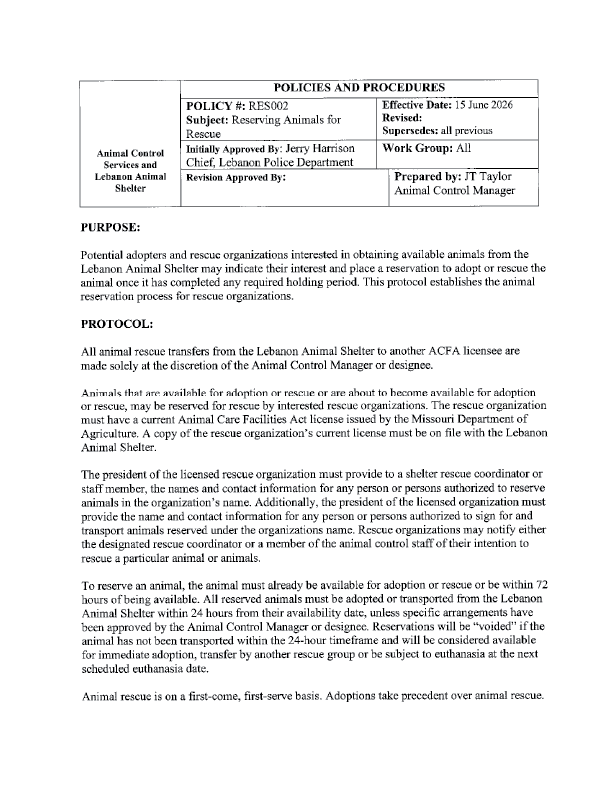
A new rescue policy, titled “Reserving Animals for Rescue,” became effective June 15, 2026.
Under that policy, a rescue organization must hold a current Animal Care Facilities Act license issued by the Missouri Department of Agriculture.
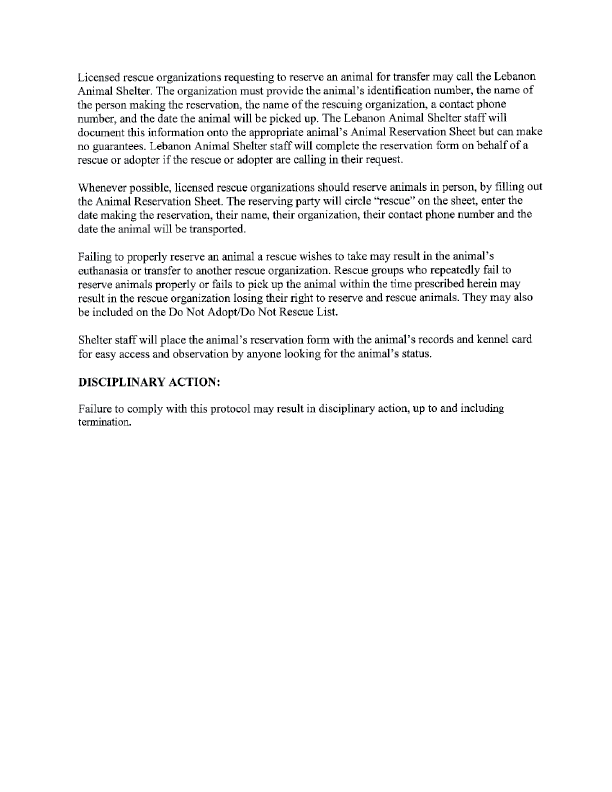
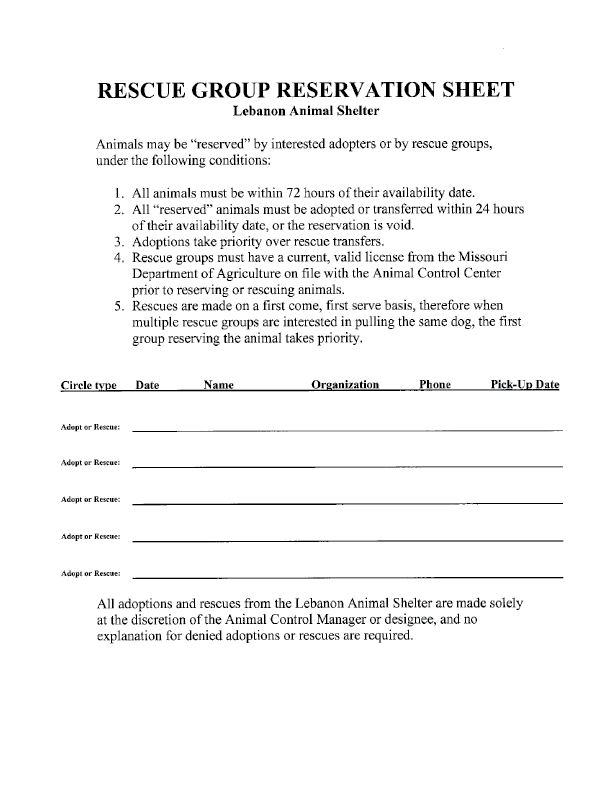
Animals may be reserved when they are available for adoption or rescue, or within 72 hours of becoming available. Once the animal reaches its availability date, the policy generally requires the animal to be adopted or transported from the shelter within 24 hours unless the Animal Control Manager or a designee approves other arrangements.
The policy also establishes that rescue transfers are first come, first served and that a direct adoption takes precedence over a rescue transfer.
The reservation sheet accompanying the policy repeats those requirements, including the 24-hour timeframe and requirement for a valid Missouri Department of Agriculture license.
Where Dunn Says the System Breaks Down
Dunn said the largest practical difference is that the system shifts responsibility away from her centralized network and toward individual rescue organizations.
Under the system she operated, Dunn actively searched for rescues, raised pledges and coordinated transportation.
She believes requiring individual rescues to make reservations and arrange transportation themselves will make it more difficult to move animals quickly.
“Rescues are busy. Rescues are full. Shelters are full,” Dunn said. “They’re not going to be out looking for animals.”
She said many rescue organizations would never know which animals were available in Lebanon without someone actively contacting them.
“I’m the one here that’s taking those pictures,” Dunn said. “I’m emailing, I’m texting, I’m messaging people in rescue going, ‘Hey, this dog has time up on this Monday. Can you help us?’”
Dunn also identified the change from roughly 48 hours to 24 hours as a major concern.
When directly asked whether that was one of the most detrimental differences between the systems, Dunn answered, “That is a big difference.”
Dunn said she did not see the written June 15 policy before this week.
She said she learned Wednesday that rescues would be expected to work directly with Animal Control under the reservation process.
“Here it is October second, and I’m just now hearing that that’s when it supposedly went into effect,” Dunn said. “And I haven’t even seen it.”
Taylor gave a different account of how the changes were communicated.
He said Animal Control held a meeting with area rescue organizations around May or early June and discussed the direction of the new procedures. Dunn confirmed attending a meeting but said she understood portions of the discussion as possibilities rather than a final explanation of the system now being enforced.
That difference in understanding appears to be one of the central points of disagreement.
Adoptions Are Not the Dispute
One issue that caused some confusion following Dunn’s original Facebook post was the policy giving direct adopters priority over rescue organizations.
During her interview, Dunn clarified that she does not oppose that provision.
“Anytime a dog can go immediately to a home is always the best option,” Dunn said.
She said returning an animal to its original owner is the preferred outcome when possible, followed by a direct adoption into a permanent home.
“Adoption is always first,” she said.
Taylor expressed the same general goal, saying the purpose of the shelter and rescue system is ultimately to get animals out of the facility and into homes.
Will Euthanasia Increase?
That is the question at the center of much of the community reaction.
Dunn fears that without the network she has built and personally coordinated, some animals will not be seen by enough rescues quickly enough.
“The last thing I want to do is have animals die,” she said.
Dunn said the current building has limited space and was not designed to hold large numbers of animals for extended periods.
“We’re going to lose lives,” Dunn said. “There’s just no way around it.”
Animal Control disagrees with that prediction.
Chief Harrison said Lebanon Animal Control has euthanized fewer than 10 percent of the animals it has picked up in 2026 and said the facility typically handles approximately 450 animals annually while remaining below that percentage.
Taylor said he does not expect Dunn’s decision to cause euthanasia numbers to increase.
He said Animal Control has access to licensed rescue organizations throughout Missouri and surrounding states and already had a contingency plan in place in case Pound Pullers was no longer able or willing to coordinate rescues.
Taylor said Lebanon’s policy is to euthanize animals that are too sick or injured to reasonably save when a veterinarian determines euthanasia is in the animal’s best interest, animals considered a serious public-safety threat, or, as a last resort, an otherwise adoptable animal when the facility has no remaining capacity.
He said the last circumstance has historically been extremely rare.
The Future of Lebanon Animal Control
The disagreement comes while the city is planning a broader transformation of its animal-control operation.
Harrison said the city intends to move toward a more proactive animal-care and control system over the next two years, eventually including a new animal shelter, an adoption center and expanded community services.
Taylor said the city also intends to begin performing direct adoptions rather than requiring every animal to first transfer through a rescue organization.
That program has not yet begun.
Taylor said ordinances must first be addressed and veterinary arrangements finalized.
Plans discussed for a future shelter include improved veterinary space, separate HVAC systems for isolation areas, facilities for exotic animals and temporary accommodations for livestock.
The proposed new facility has not yet received final city approval.
Dunn supports the need for a new building but said she remains concerned about how animals will be handled between now and whenever those future plans become reality.
What Happens Next
Dunn has not permanently closed the door on working with the city again.
For now, she said she plans to finish working with the animals she has already committed to and then take a break.
When asked whether she would consider sitting down with Taylor and Harrison, Dunn said she needs time.
“I need some time to gather myself,” she said. “I need to let my heart heal a few days anyway.”
Later in the interview, Dunn said she would consider a meeting and would make an appointment if she decides one is needed.
Harrison said the department remains willing to work with any licensed rescue partner willing to operate within the new framework.
For now, the situation leaves Lebanon Animal Control entering a new system while Pound Pullers steps away from a role it has filled for more than a decade.
Both sides agree on at least one central point: the work Pound Pullers has done has played a substantial role in getting animals out of the Lebanon facility and into homes.
Where they differ is on whether the city’s new system can accomplish the same goal without the centralized network Dunn spent 12 years building.