Local News
Lebanon City Administrator Troy Schulte Addresses Data Center Proposal, Ice Cream Factory, City Logo, YMCA and Other Community Concerns
By Lebanon Now Staff ·
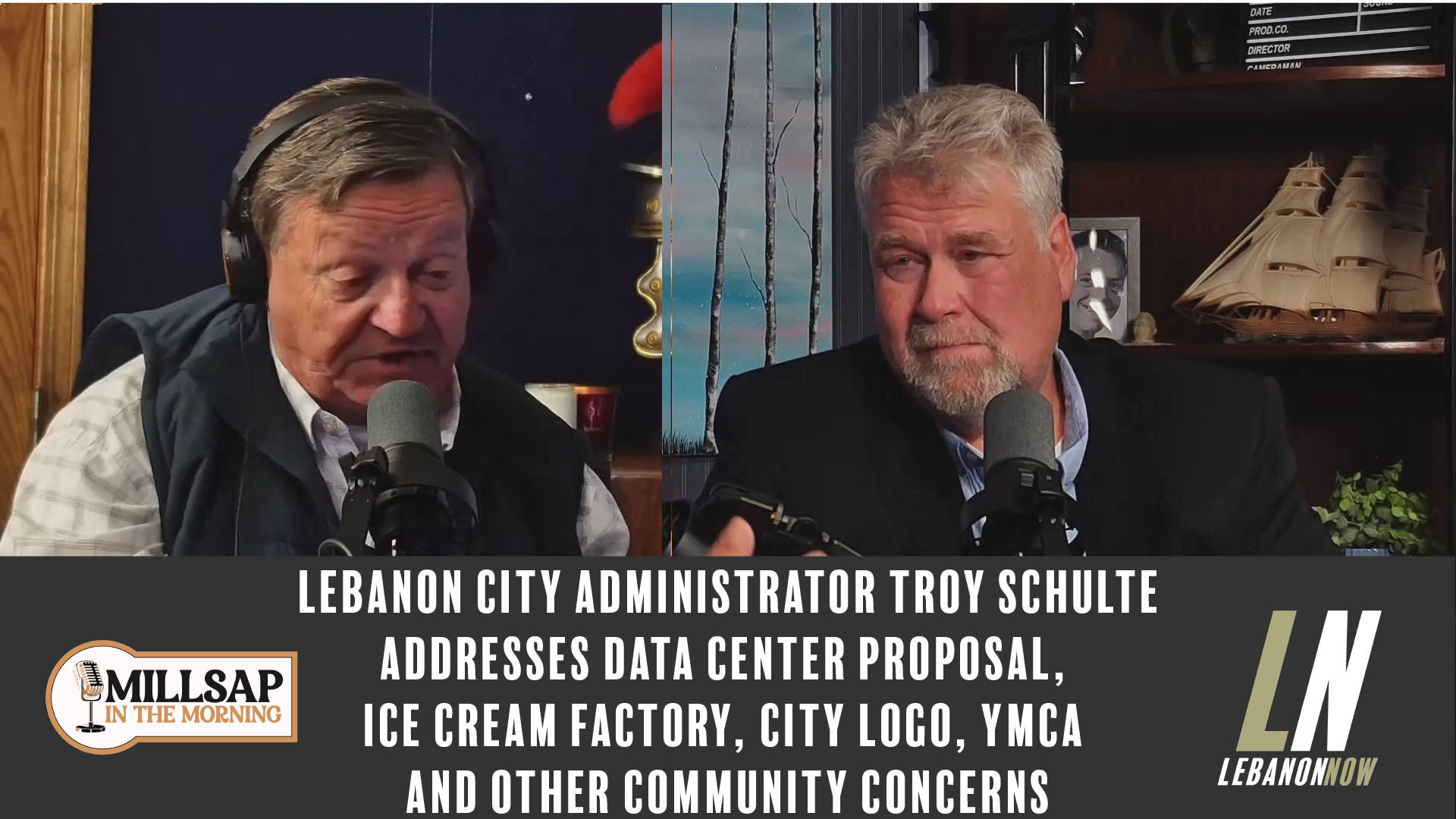
Lebanon City Administrator Troy Schulte Addresses Data Center Proposal, Ice Cream Factory, City Logo, YMCA and Other Community Concerns
From a potential data center and the troubled Ice Cream Factory to the city’s controversial logo redesign, the future of the YMCA and efforts to address deteriorating properties, Lebanon City Administrator Troy Schulte is providing answers about several issues generating public concern.
As Lebanon considers new development opportunities, infrastructure investments and changes to city services, residents have raised questions about how decisions are made, how public money is spent and whether the community has enough information about projects before they move forward.
Schulte addressed several of those concerns during an October 21 discussion with David Millsap on Millsap in the Morning, explaining the city’s reasoning, the financial considerations involved and what decisions remain unresolved.
Proposed Data Center: No Agreement, No Selected Site and Months of Research Ahead
One of the most discussed potential developments in Lebanon is a data center that could locate within the city’s industrial areas.
Schulte emphasized that the project remains in its earliest stages. A developer has expressed interest in purchasing industrial property, but no site has been selected, no agreement has been finalized and considerable research would be required before construction could begin.
According to Schulte, the potential facility would be considerably smaller than the massive data centers being developed elsewhere in Missouri.
“It is not one of the Amazon, Google or Meta, which are those massive hyperscale things,” Schulte explained.
Instead, he described a smaller operation that could provide hosting services for websites and other digital operations.
The distinction is important because much of the public discussion has centered on concerns about electricity consumption, water usage and whether residential customers could face higher utility bills.
Schulte said the city believes the proposed facility could operate within Lebanon’s electrical capacity, although engineering studies would be necessary to determine the actual requirements.
He also stated that the developer would be responsible for the costs associated with those studies and any additional electrical transmission infrastructure required for the project.
The engineering review conducted through the city’s wholesale power provider could take approximately six months.
What Could Lebanon Gain Financially?
Schulte outlined a hypothetical financial scenario involving a data center with a 30-megawatt electrical demand.
Under that scenario, the city’s five-percent utility franchise fee could generate approximately $1.8 million annually.
That money could potentially reduce pressure on other city revenue sources and provide additional funding options for public projects.
Schulte specifically mentioned the possibility of funding improvements such as a new Boswell Aquatics Center without necessarily asking voters to approve an additional tax.
He also pointed to potential benefits for the Lebanon R-3 School District through commercial property and equipment taxes.
However, Schulte acknowledged that data centers generally do not create large numbers of permanent jobs.
For the school district, he suggested that additional tax revenue without a corresponding increase in student enrollment could provide a financial benefit.
These figures remain projections based on a hypothetical development, not guaranteed revenue from an approved project.
Water Usage, Electrical Rates and Power Outages
Concerns about water consumption have been among the questions surrounding data center development.
Schulte said some facilities use air-cooling systems, while others use closed-loop water systems that continually circulate water rather than requiring a constant new supply.
He also discussed the possibility of systems using treated wastewater.
The specific cooling technology and water requirements for the proposed Lebanon project have not been established.
On electricity, Schulte said a large industrial customer could help distribute utility costs across a broader customer base.
He explained that approximately 75 percent of the city’s electric utility costs come from purchasing electricity, leaving the city vulnerable to changes in wholesale energy prices.
During a cold-weather event earlier this year, Schulte said the city’s electricity costs increased by approximately $800,000 over a single weekend. He said the city had initially anticipated the event could cost as much as $1.2 million.
Another question involved whether a data center would receive priority over residential customers during electrical outages.
Schulte said it would not.
He explained that the city already prioritizes certain critical facilities and major employers during restoration efforts, including Mercy Hospital and industrial operations.
A data center would not receive an arrangement allowing residential customers to remain without electricity simply to maintain its operations, according to Schulte.
The city also intends to consider the long-term usefulness of any facility constructed. Schulte said he would prefer a building that could eventually be converted into manufacturing space if changing technology made the data center obsolete.
For now, the city is continuing to explore the opportunity.
“This thing may collapse for forty different reasons,” Schulte said.
Ice Cream Factory: City Investment, Financial Problems and Questions About Ownership
The Ice Cream Factory has generated significant public discussion following financial difficulties, employee payroll concerns and questions about the city’s investment in the operation.
Schulte addressed the city’s involvement and clarified an important distinction: the money spent by the city went toward improvements to a building owned by the City of Lebanon, not directly to the business owner.
The property, commonly remembered as the former Modern building, is owned by the city.
Schulte said approximately $400,000 had been authorized for electrical improvements, but only about $280,000 was actually spent.
According to Schulte, the money went toward electrical services and contractors, including a company from Eldon, Missouri, that had previously worked on the facility.
“Not a dime of it went to the owner of the Ice Cream Factory,” Schulte said.
He stated that the improvements were inspected and that he personally approved the invoices.
The city’s position is that the electrical improvements remain valuable regardless of what happens to the current business.
If the Ice Cream Factory cannot continue operating, the upgraded electrical infrastructure could make the city-owned building more attractive to another manufacturer.
Schulte compared the arrangement to improvements the city made at another city-owned property leased by Copeland.
Did the City Know About the Owner’s Background?
Questions have also been raised about the background of Ice Cream Factory owner Gail Kirk.
When asked whether the city knew about her background before moving forward, Schulte said it did not.
However, he disputed the suggestion that this necessarily represented a failure in the city’s decision-making.
Schulte explained that Kirk had already acquired the business and that the city’s involvement concerned improvements to its own property.
He also referenced Kirk’s previous business experience and her acknowledgment of past legal problems.
Schulte said he believes people deserve opportunities to move forward after serving their sentences.
He maintained that the city would have considered similar infrastructure assistance for another existing Lebanon business seeking to expand.
Unpaid Employees and Utility Bills
The company’s reported payroll problems have been another source of concern.
Schulte acknowledged the situation and expressed sympathy for employees who have experienced difficulty receiving their wages.
However, he explained that employee compensation disputes fall under the jurisdiction of the Missouri Department of Labor rather than city government.
He said he believes the state agency is involved in addressing those concerns.
Questions have also surrounded the company’s unpaid utility bills.
Schulte confirmed that the business is currently operating under an installment payment arrangement with the city.
He said similar payment plans are available to residential customers and are not an accommodation reserved specifically for the Ice Cream Factory.
The city was aware the company was experiencing cash-flow problems, according to Schulte.
He said Kirk had acknowledged those difficulties when approaching the city for assistance.
Despite the uncertainty surrounding the company’s future, Schulte defended the city’s decision to invest in the electrical system of a building it owns.
The ultimate outcome for the Ice Cream Factory remains unresolved.
Lebanon’s $75,000 Branding Project: Why Change the City Logo?
Lebanon’s proposed new logo has drawn criticism from residents questioning both the design and the approximately $75,000 spent on the branding initiative.
Schulte explained that the project originated from the Lebanon 2040 Comprehensive Plan, which identified modernizing the city’s branding as a goal before he became city administrator.
The purpose, he said, was not simply to replace a familiar logo.
Instead, the city wanted to develop a more consistent identity for economic development, tourism and marketing to businesses considering investing in Lebanon.
Schulte said the city hired a Nashville-based consulting firm that conducted research involving approximately 600 people.
Of those surveyed, approximately 400 were from outside Lebanon.
The objective was to understand how people in other communities perceive Lebanon and how the city could better communicate its identity to potential visitors, businesses and future residents.
Approximately 200 people also participated in local community discussions.
Schulte said the research emphasized Lebanon’s identity as a manufacturing community.
Public Reaction and the Revised Designs
The original proposed logo, featuring a stylized letter L, received significant negative feedback.
Schulte acknowledged that reaction.
The city subsequently returned to its stakeholders with additional options.
Approximately 30 designs were narrowed to six, with one emerging as the preferred option among those participating in the selection process.
That revised design is now awaiting further consideration by the Lebanon City Council.
Schulte emphasized that the council could approve the proposal, request additional changes or decide to retain the existing logo.
He also said the city does not intend to immediately replace every existing instance of the current design.
Water towers, for example, could retain their existing appearance until they require repainting.
The city’s familiar identity and references, including its downtown arches, would not necessarily disappear under a new branding strategy.
Schulte acknowledged that the decision is ultimately up to the council.
“It’s not going to make or break the city,” he said.
He maintained that the branding effort is part of a broader strategy to attract businesses and investment rather than simply changing how Lebanon presents itself to current residents.
YMCA and Cowan Civic Center: A Decision About Public Access
The future of the YMCA’s operations at the Cowan Civic Center remains one of the city’s most significant unresolved decisions.
The current arrangement is scheduled to end June 30, 2027, and city officials are considering whether to continue working with the YMCA or adopt a different approach to operating the facility.
Schulte explained that the city has received presentations outlining both a city-operated community center model and the YMCA’s approach.
The decision now rests with the Lebanon City Council.
One of the primary questions is how the facility should serve the broader community.
Schulte described concerns about access for people who may not want or need a full YMCA membership.
He said residents have expressed interest in being able to visit the facility occasionally, pay a small daily admission and use the fitness equipment or swimming pool.
He also raised questions about how the pool is scheduled.
For example, the Lebanon school district must arrange and pay for swimming pool access while competing with other scheduled activities.
Under a city-operated community center model, Schulte suggested that public priorities could play a larger role in determining how facilities are scheduled.
That could include reserving early morning swimming hours for school programs.
He emphasized that the YMCA is operating under a different financial model and must consider membership services and operating expenses.
What Does the YMCA Pay the City?
Schulte said the YMCA occupies approximately 30,000 square feet of the Cowan Civic Center.
He described the rental rate as approximately $1.66 per square foot annually, which he said is significantly below what a comparable commercial arrangement might cost.
The city also pays utility expenses and handles major maintenance responsibilities.
Schulte said the YMCA has proposed another possible arrangement in which the city would pay the organization to manage the facility.
That option remains under consideration.
The city has also moved away from the previous long-term agreement, which Schulte said had extended toward 2045.
Whatever arrangement is selected after June 30, 2027, will require a new agreement.
Schulte indicated that he would prefer a shorter contract rather than another commitment lasting several decades.
No final decision has been announced.
Red Fox Motel and Blighted Properties: Stronger Enforcement Under Consideration
The condition of deteriorating properties throughout Lebanon has become another significant concern for residents.
The Red Fox Motel, which recently drew renewed attention following a stabbing, was among the properties discussed.
Schulte acknowledged the longstanding concerns surrounding the location and explained that the city is considering additional legal tools to address properties associated with repeated criminal activity.
Currently, much of the city’s enforcement authority relies on property maintenance and building codes.
That means officials must document violations and follow established legal procedures before taking action.
Those processes can take months or even years.
Schulte said the city intends to propose a chronic nuisance ordinance that would provide another means of addressing businesses associated with recurring criminal activity.
The proposed approach would allow the city to consider documented criminal activity rather than relying exclusively on building conditions and property code violations.
The ordinance has not yet been adopted.
Schulte also identified the former Bell Motel as another property that has presented enforcement challenges.
He said it took approximately two years to resolve issues involving trucks parked outside that property.
Demolitions and Neighborhood Cleanup
Beyond commercial properties, the city is continuing efforts to address deteriorating residential structures.
Schulte referenced the demolition of an older house at 858 Wood Street.
He said the structure dated back to the 1800s and may once have served as a stagecoach stop, but its deteriorating condition had become a neighborhood concern.
The city ultimately removed the structure.
Schulte said code enforcement and property cleanup were major priorities identified through the city’s citizen survey.
According to Schulte, respondents expressed a desire for more enforcement rather than less.
He indicated that the city intends to continue pursuing problem properties while recognizing that property owners retain legal rights and must be given the opportunity to respond through the appropriate processes.
Transparency and Public Communication: Schulte Says the City Can Do Better
Questions about transparency have accompanied many of the city’s recent controversies.
Residents have questioned when information becomes public, how decisions are developed and whether the community has sufficient opportunity to understand proposed projects before they reach the City Council.
When asked whether the city could improve its communication, Schulte’s answer was direct.
“Absolutely.”
He explained that the city’s traditional decision-making process involves developing proposals, presenting them to the council and allowing public deliberation before final decisions are made.
However, he acknowledged that residents increasingly want information earlier.
Schulte pointed to the proposed data center as an example of the city attempting to change that approach.
Rather than waiting until negotiations were further along, the city publicly acknowledged that a developer had expressed interest in Lebanon.
He said the goal was to prevent residents from first learning about a major development after decisions had already been made.
The city also faces challenges communicating through its existing channels.
Schulte observed that many residents visit the city’s website primarily when they need utility information or assistance with a service problem, rather than to follow long-term planning discussions.
He credited Lebanon Now with helping expand public access to City Council meetings through its broadcasts.
Schulte also discussed the possibility of broadcasting City Council work sessions, which would provide residents with additional opportunities to observe discussions before proposals reach the voting stage.
“I think we’ll probably do that going forward,” he said.
He encouraged residents to attend meetings, follow public discussions and communicate directly with city officials.
Schulte also emphasized that several controversial initiatives, including the branding project and discussions surrounding the Cowan Civic Center, originated from goals established in the Lebanon 2040 Comprehensive Plan.
His position is that the city is working through priorities previously identified through its planning process, even when those priorities generate disagreement.
Several Major Decisions Still Ahead for Lebanon
While Schulte provided explanations for the city’s involvement in several controversial matters, many of the underlying decisions remain unfinished.
The proposed data center must undergo extensive evaluation before the city can determine whether the project is feasible. The Ice Cream Factory’s financial future remains uncertain, although the city maintains ownership of the improved building. The proposed city logo is still awaiting council action.
The future of the Cowan Civic Center will require a decision about the city’s relationship with the YMCA, while proposed changes to nuisance enforcement could give officials additional options for addressing troubled properties.
Each issue involves different financial, legal and community considerations.
Schulte maintained that the city’s responsibility is to evaluate those considerations before making decisions, while acknowledging that communication with residents needs to improve.
For Lebanon residents, the coming months will provide additional opportunities to follow these proposals as they move through the public decision-making process.
The questions surrounding these projects have not all been answered, and the decisions have not all been made. What happens next will help determine how Lebanon approaches economic development, public facilities, neighborhood conditions and community involvement in the years ahead.Watch the whole interview here: