Local News
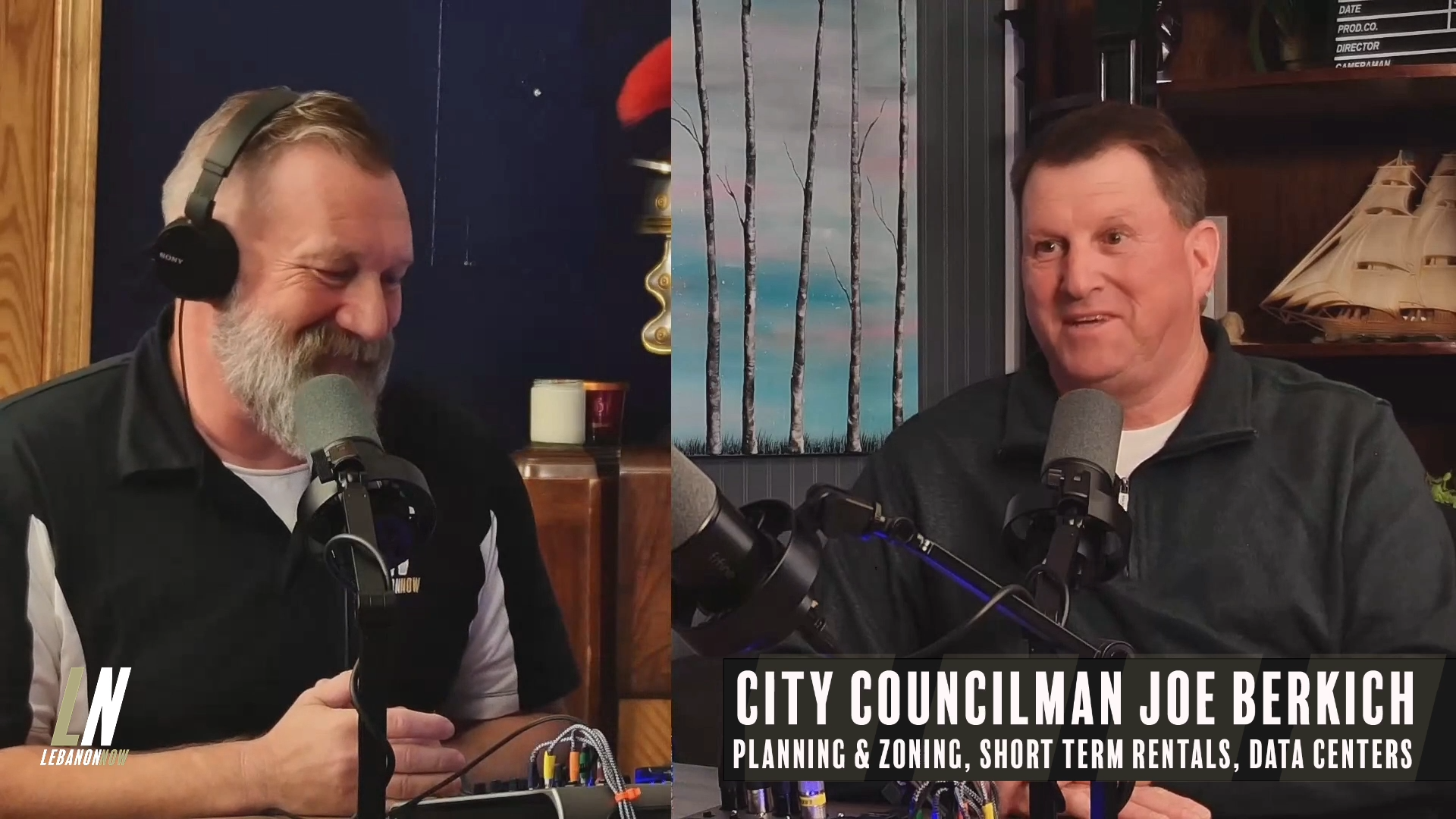
Lebanon City Councilman Joe Berkich Discusses Data Centers, Short-Term Rentals and How City Decisions Are Made
By Lebanon Now Staff ·
Lebanon City Councilman Joe Berkich Discusses Data Centers, Short-Term Rentals and How City Decisions Are Made
With questions surrounding a potential data center, proposed short-term rental regulations and ongoing discussions about the YMCA, Lebanon City Councilman Joe Berkich is helping residents better understand how decisions are made at City Hall and what happens before an issue reaches a council vote.
Berkich recently joined Lebanon Now’s Ryan Sherrer for a conversation about city government, planning and zoning, public participation and several issues currently generating discussion throughout the community.
Having lived in Lebanon his entire life and worked for the City of Lebanon for 42 years, Berkich brings decades of municipal experience to his position on the City Council. After retiring, he decided to run for office because he missed helping people and wanted to continue serving the community.
His experience working for the city has also given him a different perspective on what happens behind the scenes.
“It’s a little different from being on the staff side of the world presenting to the Council,” Berkich explained. “You’ve got to listen a lot more, and you’ve got to hear all the different views, and then you’ve got to make a decision that’s best for the city.”
Potential Data Center Raises Questions About Utilities, Environmental Impact and City Regulations
One of the most discussed topics in Lebanon recently has been the possibility of a data center locating in the community.
Berkich confirmed that City Council members have been informed that a potential developer is looking at Lebanon. However, he emphasized that many of the details residents are asking about have not yet been established.
The city is also beginning the process of developing regulations specifically addressing data centers.
Under the city’s existing zoning structure, certain industrial developments can move forward without individual approval from the Planning and Zoning Commission or City Council if they are already permitted uses within the applicable zoning district.
Berkich explained that the city wants to establish more specific requirements for data centers before a potential project moves forward.
“We’ve already discussed this with the city administrator,” Berkich said. “He is putting together that same process for data centers that will go to planning and zoning for approval.”
The goal, according to Berkich, is to determine what requirements should apply to these facilities, including where they can be located and what conditions they must meet.
Questions surrounding electricity consumption, water usage, sewer infrastructure and environmental impacts remain unanswered.
Berkich said council members have already raised those concerns.
“One was about water, sewer, electric, environment,” he explained. “So we want to address all those issues.”
During the conversation, Sherrer asked about claims circulating online regarding the potential facility’s electrical demand, including suggestions that it could require 100 megawatts or more.
Berkich said he had not received confirmed information about the proposed facility’s electrical requirements.
He recalled hearing an unofficial estimate of two or three megawatts but stressed that he could not verify that figure.
“I don’t know that for sure,” he said.
At this stage, the facility’s proposed electrical demand, environmental impact and specific utility requirements have not been confirmed through the information discussed in the interview.
Berkich also expressed interest in visiting an existing data center before making decisions about a potential Lebanon project.
“We want to know what it looks like. We want to know what it sounds like. We want to know how it affects the utilities,” he said.
He added that he intends to research the subject and ask questions before determining whether such a development would be appropriate for Lebanon.
“I can promise you, I am going to do my research on it and ask my questions, because I know that’s what the citizens want me to do.”
For now, the city is examining what regulations may be necessary while continuing to gather information about the potential development.
Proposed Airbnb Regulations Are Still Being Discussed
Another issue drawing attention is the city’s consideration of additional regulations for short-term rental properties, including those advertised through Airbnb.
Currently, short-term rentals operating as businesses in residential zoning districts must obtain conditional use approval through the city’s planning and zoning process.
Berkich explained that Lebanon’s existing regulations are limited, with requirements such as providing two parking spaces.
City staff have begun developing additional proposed regulations intended to address concerns about short-term rentals operating in residential neighborhoods.
Ideas discussed during the city’s work session included obtaining approval from a percentage of nearby property owners and establishing minimum distances between short-term rentals and locations such as schools and churches.
Among the figures raised during the discussion were 60% neighborhood approval and a 1,000-foot separation requirement.
Berkich emphasized that these proposals have not been finalized or approved.
He said he has received multiple phone calls from residents and property owners concerned about the potential changes.
After hearing those concerns, Berkich contacted City Administrator Troy to request additional discussion.
“We need to sit down. We need to have another work session. I’ve got lots of questions,” Berkich said.
The proposed changes would also go through the Planning and Zoning Commission because they involve zoning regulations. That process would provide an opportunity for a public hearing before recommendations return to the City Council.
Berkich said the primary consideration is protecting established residential neighborhoods while also recognizing the interests of property owners operating short-term rental businesses.
“So again, we’ve got to protect the residents in the neighborhood first. Then we got to look at the business,” he explained.
One concern discussed was the possibility of short-term rental properties being located near schools.
Berkich recalled a previous application involving a property near an elementary school and said the situation raised questions about who might rent the property.
However, he acknowledged that the appropriate distance requirements remain open for discussion.
“Is it one hundred foot, two hundred foot, three hundred foot, one thousand foot?” he asked. “We just need to sit down and come to a happy medium.”
The conversation also addressed the investments some property owners have made in renovating homes for use as short-term rentals and the importance of considering those businesses when developing new regulations.
Berkich said the intention is to create clear, written requirements so property owners understand what is expected before applying to operate a short-term rental.
Residents and business owners will have additional opportunities to provide input as the proposal moves through the city’s review process.
Understanding Planning and Zoning: Why Some Projects Require Approval and Others Do Not
Much of the discussion focused on an area of city government that residents may not fully understand: the Planning and Zoning Commission.
Berkich explained that not every new business, building or development must appear before the commission or City Council.
In many cases, the city’s Code Administration Department and Public Works Department are the first points of contact for someone interested in developing property.
For example, someone wanting to construct a subdivision would first meet with city staff to discuss the proposed layout, streets, infrastructure and zoning requirements.
If the development requires Planning and Zoning Commission approval, the commission reviews whether the proposal meets the city’s established ordinances.
The commission then forwards its recommendation to the City Council when council action is required.
However, Berkich explained that some developments never reach either body.
If a business is already permitted under the zoning classification of a property and no additional approval is required, the development may proceed through the appropriate administrative permitting process.
“As long as it’s a permissive use in that district, code administration will approve it and it will just get developed,” Berkich said.
This distinction is particularly important when residents question why the City Council did not vote on a particular business locating in their neighborhood.
The council does not necessarily approve each individual business that opens in Lebanon.
Instead, the city’s zoning ordinances establish which types of businesses and developments are permitted in different areas.
Berkich also explained that businesses frequently contact city staff to ask whether particular properties could accommodate their plans.
Those inquiries do not necessarily mean a business has committed to coming to Lebanon.
Some prospective developers investigate multiple properties, leave for months and never return. Others eventually purchase property and begin the permitting process.
An initial inquiry alone is not confirmation of a future development.
What Is a Conditional Use Permit, and Why Does It Matter?
Conditional use permits are another important part of Lebanon’s development process.
Berkich explained that different zoning districts have different requirements governing the types of activities and businesses allowed.
For example, a residential district is primarily intended for housing. Someone wanting to operate a daycare in that district may need conditional use approval because the proposed activity involves a business operating in a residential area.
That process provides an opportunity for neighboring property owners to express support or concerns.
Berkich said property owners within 185 feet of a proposed conditional use receive notification and have an opportunity to participate in the Planning and Zoning Commission’s public hearing.
If the commission denies an application, the applicant may appeal to the City Council.
The discussion also addressed variances, which are handled through the Board of Adjustments.
A variance may allow a property owner to deviate from certain zoning requirements when circumstances justify an exception.
For example, a property owner with an unusually small lot might request relief from a setback requirement that would otherwise prevent construction.
Berkich explained that these regulations are intended to provide consistency throughout neighborhoods while addressing safety concerns.
Building setbacks help establish separation between structures, while building codes address issues such as fire protection.
“That’s the reason why we have building codes,” Berkich said. “It’s all about safety.”
He also noted that downtown Lebanon has its own zoning classification, established several years ago to better define the types of businesses permitted in the downtown district.
These distinctions help explain why a business may be allowed in one part of Lebanon but require additional approval, or be prohibited, in another.
Why City Council Members Don’t Always Respond During Public Comments
Residents attending Lebanon City Council meetings have sometimes questioned why council members remain quiet when citizens approach the podium to express concerns.
Berkich explained that the public comment portion of a meeting is primarily intended to allow residents to present information to their elected representatives.
Speakers are given three minutes to address the council.
“We’re there to listen to what they have to say,” Berkich said.
He explained that immediately engaging in lengthy discussions or debates could prevent speakers from completing their comments and substantially extend council meetings.
Instead, council members can take notes, review concerns and determine whether an issue should be placed on a future agenda.
“We take the notes, we go back, we say, hey, you know, we need to have this topic on a future agenda. We need to discuss this,” he explained.
Berkich stressed that a lack of immediate response should not be interpreted as a lack of interest.
Residents also have opportunities to contact their representatives outside council meetings.
Council members’ contact information, including telephone numbers and email addresses, is available through the city’s website.
Berkich said he regularly receives calls and messages from residents and makes an effort to meet with people who want to discuss city issues.
He represents Ward 2 alongside Councilman Dan Mizell.
When someone from their ward contacts him about an issue, Berkich said he frequently shares the information with Mizell so both representatives are aware of the concern.
Although not every issue can be resolved immediately, he said council members work to address the questions and problems brought to their attention.
YMCA and Cowan Civic Center: A Decision That Requires More Discussion
The future of the YMCA’s relationship with the City of Lebanon and operations at the Cowan Civic Center was another topic addressed during the conversation.
Berkich acknowledged the strong feelings many residents have about the YMCA and its programs.
However, he explained that city officials must also evaluate the financial and operational considerations associated with the facility.
According to Berkich, the contract between the city and YMCA has not been revisited since 2010.
He said officials need to determine what arrangement would best serve Lebanon residents.
“Is it to continue a contract with the Y? Is it to put more programs out there?” Berkich asked.
He emphasized that those questions cannot be answered until the parties sit down and discuss the details.
“We don’t know that because we have not sat down and negotiated a contract,” he said.
The discussion highlighted the difference between public support for an organization and the city’s responsibility to evaluate agreements involving public facilities.
Berkich did not announce a final decision regarding the future of the YMCA’s operations at the Cowan Civic Center.
A Career in City Government and Continued Commitment to Lebanon
Throughout the conversation, Berkich returned to the importance of understanding the work performed by city employees and the responsibilities involved in municipal government.
After spending 42 years working for the City of Lebanon, he said one of the things he most wants residents to recognize is the dedication of the people who keep the city operating.
From water, sewer and electric crews to police officers, firefighters, parks employees and City Hall staff, Berkich said municipal employees often work behind the scenes without receiving much recognition.
“People do not know what those folks go through on a day to day basis,” he said.
He described city employees as skilled professionals who handle responsibilities that many residents may never see.
“I just cannot say enough about the city employees and the city staff of all the work that they do,” Berkich said. “I always want to lift them up every chance I can.”
For Berkich, serving on City Council is an opportunity to continue the work he began during his decades as a city employee, although he now approaches those responsibilities from the perspective of an elected representative.
As Lebanon considers potential development opportunities, new regulations and decisions about public facilities, Berkich emphasized the importance of gathering information, listening to residents and understanding the processes involved.
Several of the issues discussed, including potential data center regulations, short-term rental requirements and the future of the YMCA agreement, remain under consideration.
Residents who want to participate in those discussions can contact their council representatives, attend public meetings and provide comments as proposals move through the city’s review process.
The conversation reflects an important distinction in local government: A proposal being discussed does not necessarily mean a decision has been made, and many of the decisions residents eventually see at City Council meetings begin with months of work involving city staff, commissions and public input.Watch Full video Here: