Local News · Government · Community · Public Safety
This week in Flock Cameras : Chief Harrison Answers Questions About Flock Cameras, Privacy and Lebanon’s Proposed Safeguards
By Lebanon Now Staff ·
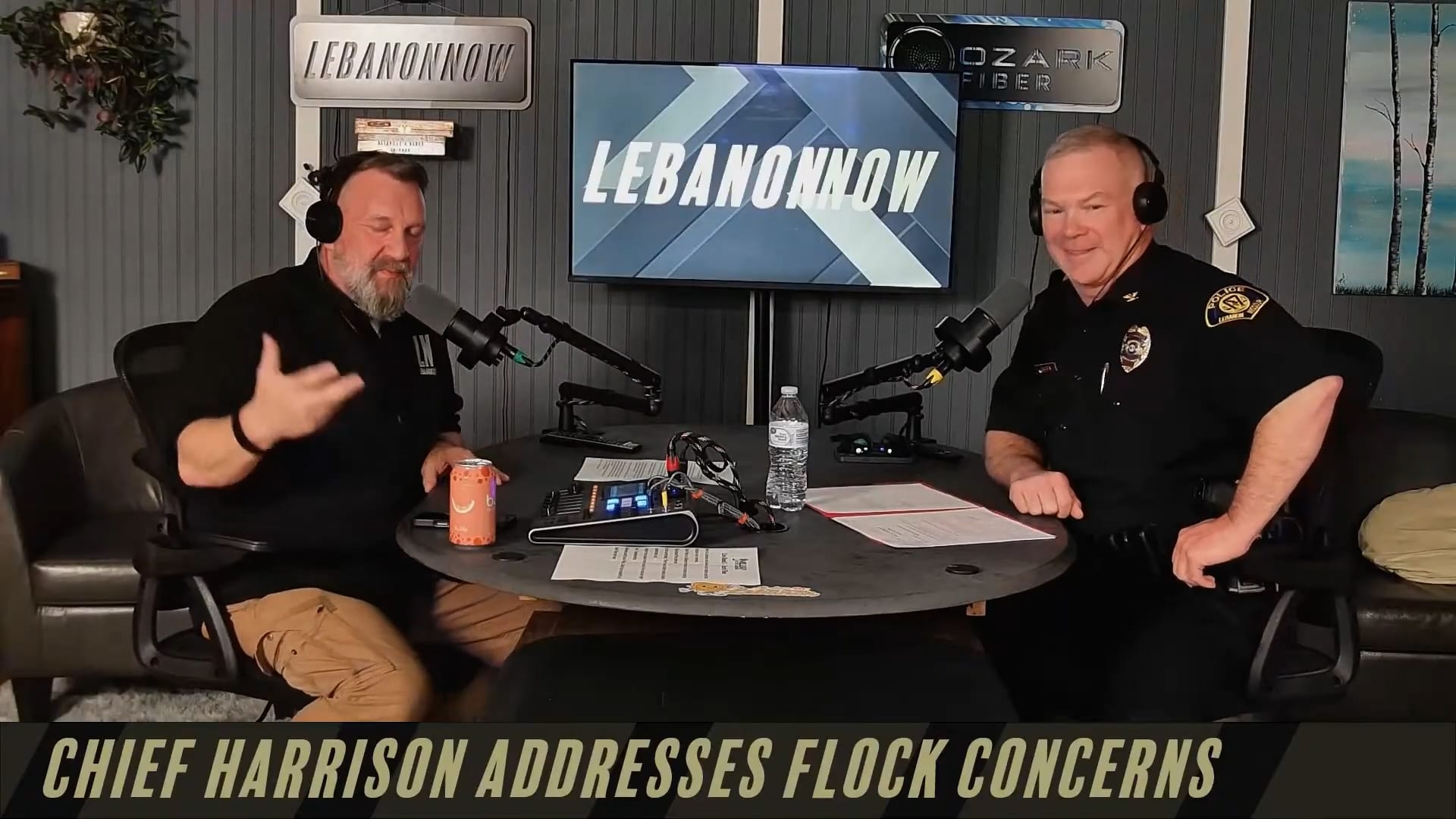
Flock cameras have become one of the most debated issues in Lebanon, with questions about privacy, data sharing, police access, potential misuse and how much oversight should exist over automated license plate readers.
Rather than continue the debate through social media posts and secondhand information, Lebanon Now sat down with Lebanon Police Chief Jerry Harrison for nearly an hour to ask those questions directly.
Lebanon Now takes no position for or against Flock cameras. The purpose of the interview was to give Harrison an opportunity to explain exactly how Lebanon Police uses the technology, what information it collects, where he believes legitimate concerns exist and what the department is doing in response to those concerns.
Lebanon Now has also reached out to DeFlock Lebanon and offered an opportunity to present its position. We are working on a scheduled date now.
Flock Is Only Part of Lebanon’s License Plate Reader System
One of the first distinctions Harrison made is that automated license plate readers are not new to Lebanon.
LPD has used ALPR technology since approximately 2021. Flock is one of three systems currently used by the department, along with Genetec and Axon.
Harrison said the arrival of Flock represented an advancement in the technology rather than Lebanon beginning license plate reading for the first time.
What has changed is the amount of public attention surrounding the technology.
Harrison said those concerns have caused the department to put existing practices and new safeguards into writing.
“We’re codifying it,” Harrison said. “We’re putting it in writing, and we’re making a commitment to the community on how we’re going to use it.”
Harrison Says Privacy Concerns Helped Shape the City’s Response
Harrison stressed that the department’s proposed rules were not created by police in isolation.
He said he met with local privacy advocates who brought their concerns directly to the department.
“We sat down together and we talked about what our values were and what we believe,” Harrison said.
He said those conversations, along with best practices and legislation previously considered at the state level, helped shape the department’s proposed approach to ALPR technology.
That approach now includes a proposed city ordinance, monthly audits, public reporting and changes to how Lebanon shares access to its system.
What Does a Flock Camera Actually Collect?
During the interview, we spent considerable time discussing what information a Flock camera does and does not collect.
According to Harrison, the system captures an image of a vehicle and its license plate as it passes a camera, along with the location and time.
He said the cameras currently being used by Lebanon do not provide a usable image of the driver and do not use facial recognition.
Harrison said the Flock system itself does not contain the registered owner’s personal information.
If police need to determine who owns a vehicle, officers must take the license plate information and separately search Missouri’s law enforcement databases.
“So when you go to Flock and you type in… you’re just looking for a tag,” Lebanon Now asked. “You can’t go, ‘I’m looking for Ryan Sherrer,’ to bring up Ryan Sherrer?”
“Correct,” Harrison answered.
He explained that officers can also search using a vehicle description when investigators do not have a license plate.
LPD’s written explanation of the program similarly states that its ALPR systems capture the exterior of vehicles and that MULES, not the ALPR system, provides registration, ownership and criminal information after a plate is searched.
How Long Is the Information Kept?
Harrison said Flock images are retained for 30 days.
An image can be preserved longer if it becomes evidence in an investigation, but Harrison said exporting that information also creates an audit trail.
“If we go in and export it out of Flock… any exports are going to show up in the audit,” Harrison said.
He said an exported image should then be connected to a police report and preserved as evidence.
“If it’s not, then now we have a problem.”
The department’s Aug. 10 letter also states that ALPR images are deleted after 30 days unless preserved as part of a case.
The Big Question: What Stops an Officer From Misusing It?
One of the central questions in our interview was not whether police officers should misuse the system. It was what happens when someone does.
Cases involving law enforcement officers improperly using databases or license plate readers have fueled part of the national concern surrounding ALPR technology.
Harrison did not argue that misuse is impossible.
Instead, he explained how Lebanon intends to look for it.
LPD is developing monthly audits covering its ALPR systems. According to Harrison, those audits can show which officer conducted a search, when the search occurred, the time range searched, the license plate or vehicle involved and the officer’s stated purpose.
The department can then compare that activity against actual case numbers and legitimate law enforcement activity.
Harrison said auditors will look for red flags, including repeated searches involving the same vehicle or person, searches without corresponding cases, inappropriate user permissions and unusual activity.
“We can see every single thing that happens inside that system,” Harrison said.
Those Audits Are Supposed to Become Public
Harrison said the department doesn’t intend to keep the results of those reviews entirely internal.
LPD plans to publish monthly information showing vehicle reads, alerts, searches, case categories, officer search totals, arrests and recoveries connected to ALPR use.
Residents would also be able to see how many searches individual officers conduct by badge number.
Harrison even provided his own badge number during the interview: 301.
“Go in there and see,” Harrison said. “When we get our audits up, you’ll see my search history in there under 301.”
The public reports would not disclose protected personnel or investigative information, but Harrison said confirmed misuse would be reported as having been detected and addressed.
What Happens If an Officer Breaks the Rules?
The department is asking the Lebanon City Council to go a step beyond internal policy by putting restrictions into city law.
Under the proposed ordinance, knowingly accessing the system without authorization, using another person’s login, allowing untrained personnel to access it, using ALPR information for personal, political or commercial purposes, or improperly disclosing information could result in a municipal violation.
Harrison read the proposed penalties during our interview: $250 for a first offense and $500 for a second or subsequent offense within a 12-month period.
We asked the obvious question: Is a $250 fine really enough to prevent police misconduct?
Harrison said the fine would not necessarily be the end of the consequences.
“If you’re not going to follow the law, you’re not going to serve the City of Lebanon,” Harrison said.
In other words, according to Harrison, intentional misuse could also cost an employee their job.
The ordinance remains a proposal and has not been adopted. It is scheduled to be discussed by the Lebanon City Council during its Aug. 24 work session.
What About Other Police Departments Accessing Lebanon’s Cameras?
This was another major part of our conversation.
Harrison said Lebanon currently shares through the Flock network with more than 1,200 agencies.
That immediately raises another question: Lebanon may create rules for its own officers, but what happens when another agency accesses Lebanon’s system?
Harrison said LPD is creating what it calls a “Verified Partner Agency” system.
The department is reviewing agencies it shares with through open-source research, looking specifically for evidence of ALPR misuse. If misuse is found, Harrison said LPD will examine how the agency responded.
If that agency’s handling of ALPR technology does not align with Lebanon’s standards, Harrison said Lebanon will stop sharing with it.
Under the proposed ordinance, all agencies would have to be verified by Jan. 1, 2027 and then reviewed again on a two-year cycle.
Harrison said sharing is also one of the reasons he believes Flock can be valuable.
He described a case from his time as police chief in Independence, Kansas, involving an abusive father who took his children and fled. Harrison said Flock alerts helped law enforcement follow the vehicle across multiple jurisdictions before the children were recovered approximately 10 hours away in Tennessee.
For Harrison, that ability to communicate across jurisdictions is one of the strongest arguments for maintaining some level of information sharing.
Can Flock Itself Be Trusted?
We also asked Harrison about something that exists beyond the actions of Lebanon Police: concerns about Flock Safety itself.
If Lebanon creates strict rules for its officers, what prevents the company operating the network from allowing access or using information in ways the city does not intend?
Harrison said Lebanon can audit which agencies access its system and what they access.
He also said the City of Lebanon owns its data and that, under the city’s agreement, it is not sold to third parties.
That does not mean critics are satisfied.
DeFlock Lebanon continues to advocate for removing the cameras entirely and raises broader concerns about networked surveillance, data sharing, warrantless searches and whether safeguards controlled by police or Flock are sufficient.
A Change.org petition is also circulating calling for the cameras to be removed.
Those concerns remain part of the local debate.
But Who Audits the Police?
This may have been the most difficult question of the interview.
If Lebanon Police audits Lebanon Police, residents skeptical of the system may still question whether that represents independent oversight.
Harrison acknowledged the concern.
“The only one that I haven’t worked through yet is that we want an outside entity to audit these audits,” Harrison said of concerns brought to him by activists.
He said there are legal and security complications because an outside auditor would potentially need access to protected criminal justice systems and information.
Harrison said possible options could include another authorized law enforcement or criminal justice agency, such as the Laclede County Sheriff’s Office or Laclede County Central Dispatch.
He said discussions are underway but emphasized that he was not committing to an outside auditing arrangement yet.
“That’s the best answer that I can come up with for you right now,” Harrison said. “I’m not saying we’re going to do that, but we are talking with our partners.”
Harrison Says A Flock Hit Alone Isn’t Enough
Another safeguard discussed during the interview involves what happens when a camera alerts police to a wanted vehicle.
Harrison said Lebanon officers are not supposed to make an enforcement decision based solely on a Flock alert.
Instead, the officer must confirm the license plate through Missouri’s law enforcement system before taking action, except for limited circumstances involving an immediate public safety issue.
That requirement is included in the department’s proposed rules.
LPD’s written explanation also says officers receiving an ALPR hit must confirm it through MULES before determining ownership, vehicle information and the nature of the associated crime.
What Has Flock Done in Lebanon So Far?
Harrison’s Aug. 10 letter provides the department’s first broader accounting of results attributed to the system.
Lebanon’s first three Flock cameras were installed during the final week of February. As of Aug. 10, eight cameras were installed, which Harrison said represents about one-third of the planned Flock system.
According to LPD, during roughly five months the system contributed to eight cases being cleared by arrest, recovering a missing person, recovering a person in crisis and generating leads in eight additional cases.
Police also reported recovering a stolen trailer, firearm and drugs.
The Debate Has Also Led to Vandalism
The controversy surrounding the cameras has now included two incidents of vandalism involving Lebanon Police camera equipment.
In July, cameras and a sign at Boswell Park were spray-painted. Police said that case was solved after investigators reviewed footage from the cameras themselves.
A second incident occurred overnight Aug. 9 involving a license plate reader near Atchley Park. Police announced Aug. 11 that the case remained under investigation.
Regardless of where someone stands on the larger Flock debate, damaging public property is a separate issue from debating whether the technology should remain in Lebanon.
Harrison: If Lebanon Doesn’t Want Flock, Police Will Continue Without It
At the end of the interview, we gave Harrison the final word.
His answer was notable because he did not argue that Lebanon Police cannot function without the cameras.
“The men and women of the Lebanon Police Department have been making police cases way before Flock came along,” Harrison said.
“If our community feels strongly that we should not have Flock, we understand that. And we are here to serve.”
Harrison said the department’s authority ultimately comes from the citizens it serves and said LPD would continue policing Lebanon without Flock if that is what the community ultimately asks.
His request was that residents research the issue before making that decision.
“Do your own research before you make a decision either way,” Harrison said.
One Day Later, Flock Announces Additional Safeguards
One day after Lebanon Now’s interview with Chief Harrison, Flock Safety published an Aug. 13 announcement outlining additional privacy, security, accountability and transparency safeguards for its license plate reader network.
The timing is notable because several of the issues addressed by Flock are the same issues discussed at length during our interview with Harrison, including unauthorized access, police misuse, data sharing, auditing, security and public transparency.
Flock says it is strengthening account security through mandatory multi-factor authentication and commissioning an independent security review by cybersecurity firm Bishop Fox. The company also announced a Coordinated Vulnerability Disclosure program and said it is expanding safeguards surrounding ALPR accuracy, access, sharing and review. Flock reiterated that its customers retain ownership and control of their data. (Flock Safety)
This is particularly relevant to one of the questions Lebanon Now raised directly with Harrison: How does Lebanon protect against potential problems involving not only the officers using the system, but the company operating the network?
That concern is not entirely theoretical.
Flock previously acknowledged that some California law enforcement agencies had camera networks that were inadvertently accessible to out-of-state law enforcement agencies during 2025. The company said it regretted the “confusion and mistrust” created by those incidents and implemented additional restrictions in California intended to prevent unauthorized interstate sharing. (Flock Safety)
Flock’s Aug. 13 announcement does not settle the debate over whether Lebanon should continue using the technology. It also does not eliminate the questions being raised locally about oversight, privacy and trust.
It does, however, show that several of the concerns being discussed in Lebanon are also issues Flock itself is responding to nationally.
The Conversation Isn’t Over
There are legitimate questions being asked about ALPR technology in Lebanon.
There are also now specific answers and proposed safeguards from the police department that can be examined, challenged and discussed.
The proposed ordinance is not yet law.
The monthly auditing system is still being implemented.
The possibility of an outside auditor has not been resolved.
DeFlock Lebanon continues to advocate for removal of the cameras.
Flock Safety itself is announcing additional safeguards.
And the Lebanon City Council still has decisions to make.
The next major public discussion is expected during the Aug. 24 Lebanon City Council work session, when the proposed ordinance governing ALPR use is scheduled to be discussed.
Lebanon Now will continue covering that process and providing information from those involved on both sides of the issue.
Sources and Additional Information
Lebanon Police Department Camera Program & Transparency:https://www.lebanonmissouri.org/1079/Camera-Program-Transparency
Lebanon Police Department Proposed Ordinance:https://www.lebanonmissouri.org/1080/Proposed-Ordinance
Lebanon Police Department ALPR Frequently Asked Questions:https://www.lebanonmissouri.org/m/faq?cat=30
Flock Safety, “Flock Updates Privacy, Accountability, Security, and Transparency Safeguards”:https://www.flocksafety.com/blog/flock-guardrails-address-lpr-privacy-concerns-and-police-transparency
Flock Safety, California ALPR Guardrails:https://www.flocksafety.com/blog/flock-implements-enhanced-guardrails-across-california-to-ensure-lawful-and-responsible-use-of-lprs
DeFlock Lebanon:https://deflock-lebanon.org/
Change.org, “Remove Flock Cameras in Lebanon, MO”:https://www.change.org/p/remove-flock-cameras-in-lebanon-mo
Additional source material: Lebanon Now’s interview with Lebanon Police Chief Jerry Harrison and Chief Harrison’s Aug. 10, 2026 letter to the community.